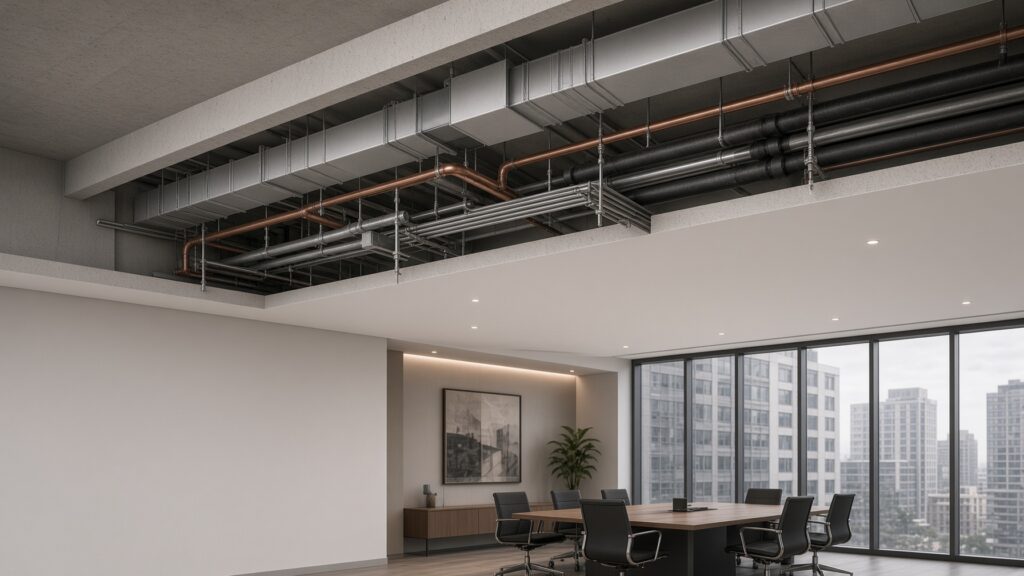
Before buying a building, estimate the remaining life and condition of the major MEP systems: the central plant or HVAC, the electrical service and distribution, the plumbing and drainage risers, and life safety. The work has three parts: collect documents, run an engineering assessment, and price the findings into the deal.
What MEP systems should you check before buying a building?
The first thing to do before acquiring a property is to estimate the life remaining and condition of the major MEP (mechanical, electrical and plumbing) systems: central plant or HVAC (heating, ventilation and air conditioning), the electrical service and distribution equipment, the plumbing and drainage risers, and the life-safety systems.
This due diligence is comprised of three main tasks: document collection, engineering assessment, and incorporation of findings into deal pricing. This assessment is about the systems that you cannot see and that cost the most to replace.
Those high-ticket, long-lead, and hard to replace: central plant or HVAC (the most expensive and disruptive item in case of its failure); the electrical service and distribution (to evaluate capacity to serve future usage and to ensure equipment safety and compliance); domestic-water and drainage risers (hidden inside walls and hard to replace once building is occupied); and the life-safety systems (fire pump, alarm, sprinklers and generator).
Two main questions about each system are to be answered: how many years of life remaining, and how much money when the life ends. This information rarely comes out of the disclosure made by the seller.
What documents should you pull in MEP diligence?
In addition to the walk through, documentation uncovers important information.
Minimum set of documents includes:
- 12-24 months utility bills (to establish a baseline of energy and water usage and the direct reading of operating expenses and NOIs).
- Inventory of equipment with nameplate data and installation date for chillers, air handlers, boilers, elevators, generator and fire pump.
- Documentation of maintenance and warranty agreements (who had done maintenance on the systems, how consistent the maintenance, recurrent failures).
- MEP documents as-built, load calculations, permits, certificate of occupancy and any outstanding/expired permits with AHJ.
- Fire safety inspection/certification documents (fire alarm and sprinkler (NFPA 25/72), fire pump and generator load tests, elevator state certificate, backflow test).
- Information about type of refrigerant and refrigerant logs, any engineering report or system conditions assessment.
Any lack of documentation is a finding itself: a plant without maintenance history should be treated as neglected.
What is a property condition assessment (PCA)?
Systematic evaluation of the property’s physical systems according to ASTM E2018 standard.
PCA combines visual inspection, documentation review and interviews with facility personnel in order to document each major system condition, deficiencies, estimated remaining useful life, and cost of repair, all organized in the immediate needs, short-term repairs and long-term capital reserves table (usually for the period of five to twelve years).
The capital reserve schedule is the number that needs to be taken into account in the financial model. CAUTION: a standard PCA usually ignores importance of MEP systems, for those systems that have significant capital risk, you need to commission MEP assessment performed by an engineer.
How do you estimate remaining useful life, and catch obsolescence?
By correlating age with the condition of the system, and by finding obsolescence that ends useful life of the system independently of its condition. Commercial HVAC equipment usually lives 15-20 years, chillers 20-25 years. Well-maintained older unit may have several years of life left, while neglected may fail sooner.
The assessment considers the maintenance history, run-hours and wear and tear of the system.
But there are two factors that are more important than the age-condition correlation: first, the refrigerant (if the system uses R-22 or R-410A – the system is subject to EPA AIM Act phasing out with increasing recharge cost and eventual replacement despite operational status); second, obsolete or hazardous electrical panels (Federal Pacific, Zinsco, Challenger, Pushmatic), they are likely to fail, and may increase your insurance premium or make your building uninsurable, thus making it a financing issue.
Any of these findings requires pricing replacement.
The negotiated price is fair only if it takes into account the plant to be replaced within a short horizon.
What hidden costs does a renovation or repositioning trigger?
This question often catches off guard value-add purchasers.
The renovation in an existing building triggers existing building code (IEBC or Florida version) depending on the scope and kind of construction. When construction touches roughly 50% of the building or changes its use, you may be forced to bring the whole structure up to current standards concerning egress, fire protection and accessibility (not just the affected area).
Change of use also triggers current ventilation (IMC) code, energy code (IECC), and in case of new occupancy, also fire alarms and sprinklers (as if it was a new building). In the High-Velocity Hurricane Zone, any replacement of the exterior equipment must comply with current product approvals.
None of the above items appears in the rent roll, but all these fall on the purchaser’s shoulders that planned the repositioning without budgeting for code-path consequences.
How do the findings change the deal?
They give you leverage or a reason to walk away.
The immediate and capital reserve number allows to pursue one of the following courses of action: to discount the purchase price by the amount of near-term capital required, to negotiate seller credit or escrow for specific items, to set aside capital to avoid problems down the road, or to walk away if the required capital makes your deal less profitable.
The utility baseline allows to do two things at once: inefficient systems increase operating expenses and thus decrease NOI at any given cap rate. The assessment cost is insignificant compared to the risk of mispriced plant, service or riser path.
The recommendation. Commission the MEP-focused property condition assessment prior to closing, based on the list of documents above, and to use the capital numbers and any findings about refrigerant, panel or code-path issues to discount the price, negotiate the seller credit or set aside the capital.
The cost of the assessment is insignificantly compared to the cost of inheriting an undercapitalized or non-compliant plant, service or riser path at the end of its life.
We can help deliver a MEP-focused property condition assessment for acquisitions, as part of our Integrated MEP Design service. The findings are only useful if they arrive inside the contingency period, so timing matters. If you are under contract on a building, reach out to us early.
Sources: ASTM E2018 — property condition assessments · PCA scope — MEP systems & remaining useful life · IEBC / existing-building code — renovation & change-of-use triggers · Obsolete panels — hazards & insurance implications · EPA AIM Act — R-22 / R-410A phase-out