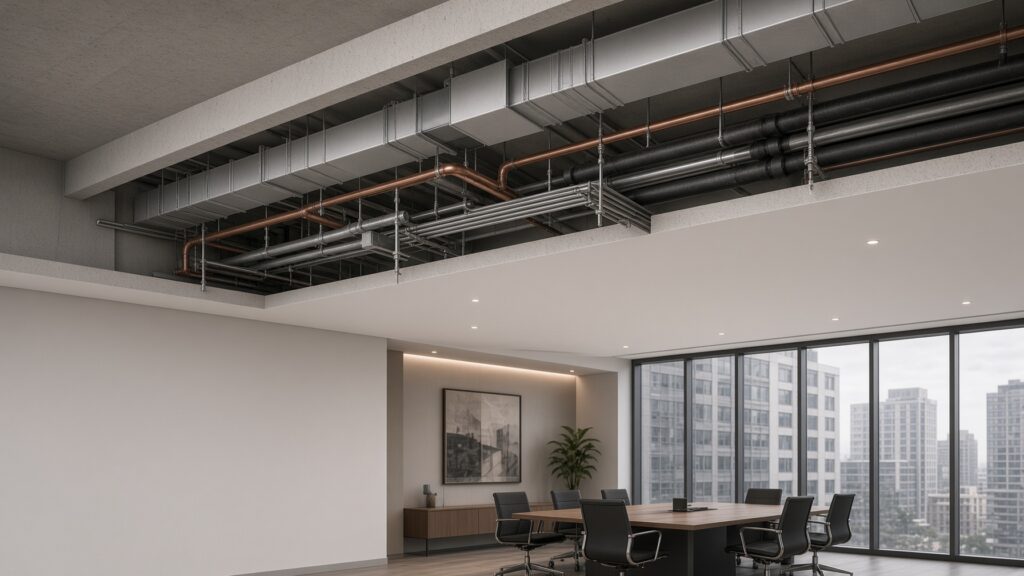
In Florida, an all-electric multifamily building is usually the more economical configuration. It costs less to build because there is no gas piping, and less to operate because a heat-pump water heater beats gas in this climate. The savings come from the heat pump, not cheap electricity, and the decision belongs at schematic design.
Is an all-electric building cheaper to build than a gas building?
For a multifamily building in Florida, the all-electric configuration is typically a more economical choice on a projected basis. Specifically, it is both cheaper to build since it does not involve gas piping, and cheaper to operate since a heat-pump water heater is more economical than gas in this region.
Note that the operating economics is the result of the heat pump and not cheap electricity, more on that follows. Florida features two mild climate zones, 1A at the southern end and 2A for the rest, and in either there is no heating season that is long enough to justify using gas.
Gas is used for hot water generation and cooking, electrification of which takes care of eliminating the need to pipe gas to the building. The decision should be made early, when it affects gas infrastructure, electrical service, hot water and ventilation design.
Most of the time, yes, mostly due to what is being left out. An all-electric choice allows the developer to eliminate the gas service, gas meters, regulators and piping completely, along with the permitting, trade work and inspections that come with it.
It also means elimination of combustion venting, flues and roof penetrations needed by gas water heaters and range, and hence makes shaft space available and simplifies the roof construction. In a building with five units or more, the majority of gas consumption is accounted for by domestic hot water; once electrified, there is little gas left to be served.
Removing the last gas appliance eliminates 100 percent of the gas infrastructure, and offsets the premium price of electric equipment.
Does all-electric cost more or less to operate in Florida?
Let’s first conduct an apples-to-apples comparison, as the answer is nuanced.
While a therm of gas costs about $2.04 in Florida, corresponding 29.3 kWh costs about $0.070 per kWh, cheap compared to electricity priced at ~$0.12 per kWh. Just on the base of raw cost of fuel, the cheaper choice is gas.
However, the comparison is reversed once the efficiency of the appliances is taken into account. A gas storage tank (about 60% efficient) heats up water at $0.116 per kWh; a condensing or tankless gas water heater (about 80% efficient) consumes $0.087 per kWh.
An electric resistance water heater (about 95% efficient) has a higher cost, about $0.126 per kWh, more than gas. However, heat pump water heater, delivering approximately three times the heat per each kWh consumed (COP ~3), delivers hot water for about $0.040 per kWh, one third of the cost of gas and half of the cost of condensing gas heater.
Thus, the operating advantage is real, but it is heat pump working, and not cheap electricity, this latter is more expensive fuel. Replacing heat-pump with a resistance tank heater reverses the result in favor of gas.
Using EPRI’s annual figures, the cost of heating water is $96–$224 vs $190–$310 for gas, a consistent conclusion from the annual cost of energy standpoint.
What replaces gas, and does Florida’s climate change the math?
The scheme includes heat pump water heaters for domestic hot water, induction or electric ranges for cooking and heat pumps for the limited winter heating needs in Florida.
The latter statement is a nuance specific for the whole state: South Florida (zone 1A) has no significant heating season; North and Central Florida (zone 2A) have a limited, mild heating season, which is usually covered by heat pumps with electric resistance heat back up only in very cold mornings.
There is no need for a gas furnace anywhere in Florida. The hardest to electrify part, winter heating, is not an issue in Florida, hence justifying all-electric configuration as compared to other states.
In a mild climate, gas is mainly used for water heating.
Once the water heating is electrified, the role of gas piping is minimized.
What does all-electric change in the mechanical and plumbing design?
It means more than substitution of the appliances.
Heat pump water heater pulls heat from ambient air, requiring proper ventilation; in a small closet, it must be either ducted, supplied with make-up air, or will rely on resistance heat, an expensive solution, as the above-mentioned calculations show. It also generates condensate, and hence requires new plumbing to be designed and run.
On a multifamily scale, it brings the choice between individual unit water heaters and heat pump water heating system with storage; because heat pumps are slower heating the water as compared to gas, the storage size is dictated by peak demand of the building rather than fast re-heating capacity of the gas unit.
Plumbing-wise, all-electric eliminates gas piping, meters and regulators, and the safety concerns coming with it. In regards to cooking, induction range produces no combustion products, making the exhaust and make-up air needs smaller as compared to gas range, as well as improving indoor air quality.
How does all-electric change the electrical design?
It increases the building connected load, and the situation is more nuanced than a common misconception that heat pumps have smaller loads. There are two loads that mainly influence this issue.
The larger one is cooking: an induction range requires a dedicated 40–50-amp, 240-volt circuit per unit, while a gas range requires no such load.
The second load comes from water heating and consists of a 30-amp, 240-volt circuit per unit, and the nuance is here: a hybrid heat-pump water heater can feature 4,500-watt resistance heat backup, so its circuit is the same as for the standard electric tank, although its regular operation relies on heat pump at 500–600 watts consuming 60–70% less energy.
The heat pump reduces energy consumption, but not circuit load.
Diversity factor restrains service requirements rather than the appliance itself. Under NEC 220 code, a multifamily service can be sized based on the staggered nature of the loads, with demand factors ranging from 45% for 3–5 units to 23% for 62 units and more, so the total service gets much smaller than unit-by-unit load.
If service headroom is limited, the possible choices include lower-amperage or 120-volt heat-pump-only water heaters (with smaller or even eliminated resistance heat element), centralized hot water system with controls or active load management, that is trading some performance or initial cost for smaller service load.
With intentional sizing of the service at the schematic stage, the all-electric service becomes a known quantity rather than an unexpected upgrade found late in the project.
The strategic advantage of all-electric is that this configuration is easily adaptable for solar PVs and EVs. Single energy source, appropriately sized with the headroom, allows easy installation of photovoltaic arrays, battery storage or EV charging later without the need for re-piping the building and coordination with a utility company.
The recommendation. Decide on all-electric configuration at the schematic stage, with the help of the MEP engineer conducting the comparative analysis for the building. Take into account the avoidance of the gas infrastructure and venting, against the premium for electric equipment, hot water heating configuration (individual vs centralized and sizing of the storage), and the impact of the service load.
All-electric configuration is favorable in Florida, but it depends on heat pumps instead of resistance water heaters and deliberate service sizing.
We can help run this comparative analysis for multifamily buildings, including the hot-water configuration and the service sizing, as part of our Integrated MEP Design service. If you are weighing all-electric on a project, get in touch and we will walk through the numbers with you.
Sources: Heat-pump water heater operating costs (Florida rates) · HPWH circuit sizing & lower-amperage options · NEC 220.84 — multifamily demand factors · All-electric multifamily — avoided gas infrastructure · Whole-home / building electrification cost