Four decisions, and the first one is made by a water flow test rather than by your design team. Whether you need a fire pump, whether you need a tank, which standpipe class the building requires, and how the occupancy classifies. Together they separate a routine sprinkler package from a mechanical room, a pump and a generator.
What decides whether you need a fire pump?
Arithmetic between two numbers. On one side, the hydraulic demand of the most demanding area in the building. On the other, what the municipal supply can actually deliver.
The supply number comes from a water flow test, and it has to be recent: commonly within the past year, since supply conditions change. The demand number comes from the sprinkler design and, where standpipes are required, from the pressure they need at the top of the most remote riser. Subtract one from the other, allow a safety margin, and the gap tells you whether a pump is in the project.
Order that test early. It is inexpensive, it expires, and it decides a six-figure question before anyone has drawn a riser.
What does the height of the building change?
It changes the standpipe requirement, which often drives the pump.
Under Section 905.3.1, Class III standpipes are required where the floor level of the highest story sits more than 30 feet above the lowest level of fire department vehicle access, or where the floor level of the lowest story sits more than 30 feet below the highest level of that access. An exception permits Class I instead in buildings equipped throughout with an automatic sprinkler system, which covers most new mid-rise construction here.
The demand that standpipes create is what often drives the pump. Pressure has to be available at the topmost outlet of the most remote riser, and every additional riser adds flow to the total. On a tall building that combination is frequently more than a municipal supply delivers on its own, which is the moment a pump enters the project.
Where does the cost concentrate?
Not in the sprinkler heads. In everything the pump brings with it.
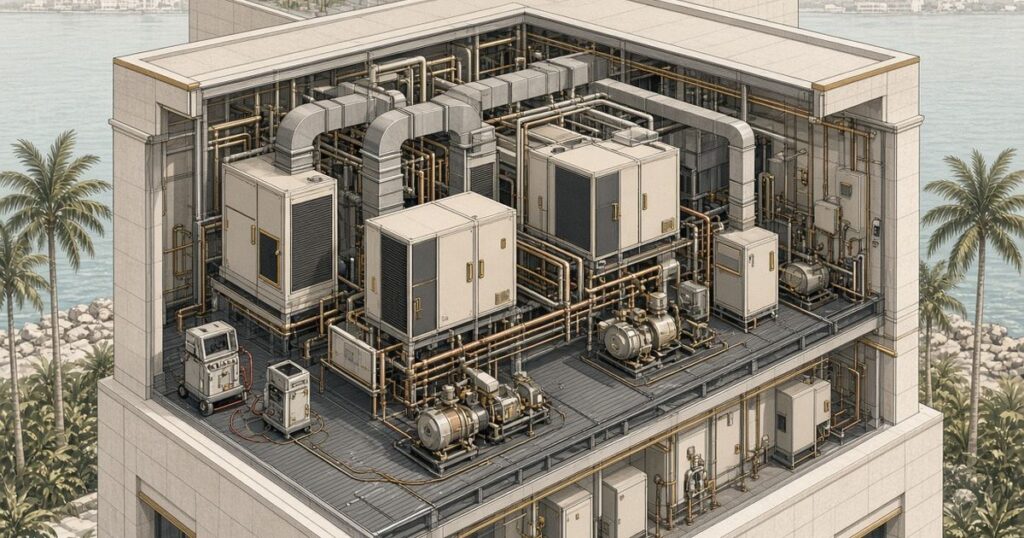
A fire pump needs a room, which needs to be located, enclosed and accessible. It needs a reliable power supply under NEC 695, which means a separate utility connection, on-site power production or a dedicated feeder, routed so that a fire in the building cannot disable it. If the authority having jurisdiction does not accept the utility as a reliable source under NFPA 20, the building needs a second independent source, whether a second utility feed, on-site generation or a diesel-driven backup pump. If the water supply is inadequate as well as low-pressure, it needs a tank, which needs structure and space.
That chain is why fire protection scope moves in steps rather than gradually. You are either under the threshold or you are buying the whole assembly.
What can actually change the answer?
A few things, and they all have to be decided early.
Site selection and the main serving it, since a different street can mean a different flow test. Building height against the 30-foot trigger, which is an architectural decision with a fire protection consequence. And in non-high-rise buildings, a manual standpipe, where the fire department pumper supplies the pressure through the connection, can remove the standpipe demand from pump sizing entirely.
Occupancy classification sets the sprinkler density underneath all of it, which is why a change of use late in design is rarely as simple as it looks.
The recommendation. Pull the water flow test during due diligence, not during design. It is the cheapest number on the project and it determines the most expensive branch in the fire protection scope. Then set building height against the standpipe trigger knowingly, rather than discovering it after the massing is fixed.
We design fire protection alongside the rest of the MEP scope, including the flow test review, pump and tank decisions and the standpipe arrangement, as part of our Integrated MEP Design service. The fire protection branch is decided early and priced late, which is the wrong order. If you are evaluating a site, email the address and the proposed height to info@resilientequities.com.
Sources: NFPA 20 fire pump design, flow test, demand and sizing · When are standpipes required, IBC 905.3.1 and classes · Fire pump power service under NFPA 20 and NEC 695