For a growing share of buildings, no. The energy code requires commissioning once the mechanical systems reach a certain size, and the threshold is capacity rather than floor area, which catches owners who assumed a mid-size building was exempt.
When is commissioning actually required?
By cooling capacity, not by building size. Under the Florida energy code, commissioning provisions apply where the total cooling equipment capacity exceeds 480,000 Btu/h, which is 40 tons. Broward County’s own enforcement guidelines state the trigger in exactly those terms. Below it, commissioning is your decision rather than the code’s.
Multifamily has a wrinkle that decides the answer for most projects. HVAC units serving dwelling units or sleeping units are excluded from that total. So a 200-unit building with a fan coil in every apartment can carry enormous aggregate capacity and still fall below the threshold, because only the central and common-area equipment counts toward it. A smaller building with a central plant can land above it. How the building is served matters more than how big it is.
Code-minimum commissioning is also a floor rather than a program. It covers specified systems to a specified depth. It is not the same as commissioning the building.
Does it pay for itself where it is not required?
The reference numbers say yes. PNNL’s guide to the Lawrence Berkeley work puts new-construction commissioning at a median 13% whole-building energy savings with a payback near 4.2 years, at a planning figure of roughly 0.4% of total construction cost.
Energy is the measurable half. The other half is warranty. A defect found before turnover is corrected on the contractor’s schedule and the contractor’s money; the same defect found eighteen months later is an operating expense with your name on it.
Who pays, and whose budget does it sit in?
The owner’s. The commissioning authority has to be independent of the party whose work is being verified, which means it cannot sit inside the general contractor’s number without defeating the purpose. If it appears there, read carefully to see what is actually being offered. Self-verification is not commissioning.
Budget against construction cost rather than per unit, since the work scales with systems rather than apartments.
Who tests whether the systems talk to each other?
This is the piece that catches owners late, because conventional commissioning does not cover it.
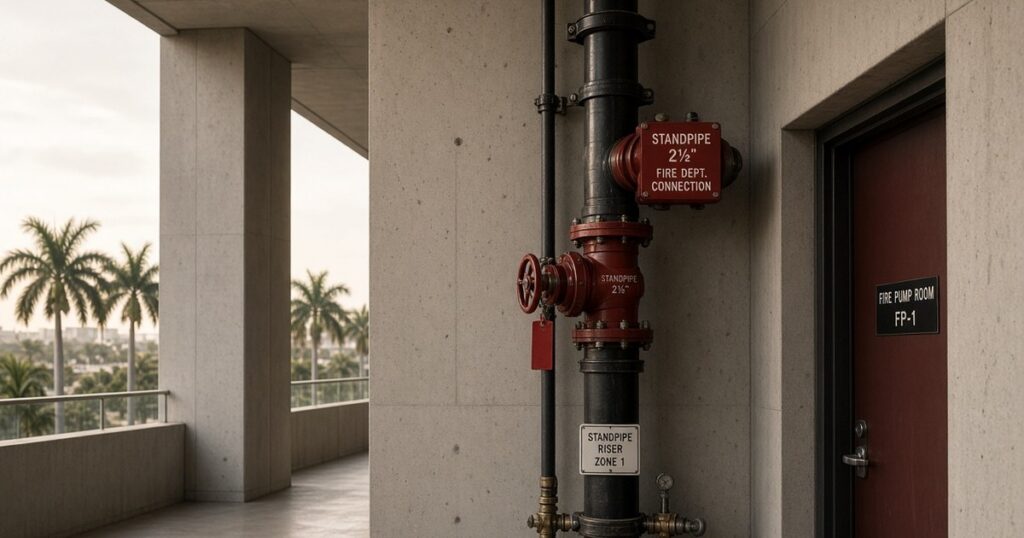
NFPA 4 integrated system testing verifies the handshakes between systems rather than each system alone: duct detectors closing smoke dampers, firefighter elevator recall, egress door locking releasing on alarm. Jurisdictions on the 2018 IBC or later apply it to new construction and renovation in high-rise buildings and buildings with smoke control.
The documented failure pattern is paperwork. Missing fire alarm matrices, missing sequences of operation, undocumented modifications, turning into permitting delays, occupancy delays and sometimes redesign, at the exact point in the schedule where none of those are affordable.
The recommendation. Find out whether your mechanical capacity puts you above the threshold before you decide anything, and if it does, write the requirements into the specifications so the contractor bids work that includes being verified. Bring the commissioning authority in at substantial completion and the tests become a negotiation with no contractual basis and no schedule left.
We track new buildings against their design energy targets through the first year of operation, comparing actual utility data to the energy model so drift is caught while it is still a warranty conversation, as part of our Energy Management & Performance service. A building that performs as designed in year one keeps performing; one that drifts rarely corrects itself. If your building has been open six months and the utility bills are running ahead of projections, email them to info@resilientequities.com.
Sources: Broward County commercial energy guidelines, C408 commissioning trigger · PNNL, A Guide to Building Commissioning · NFPA 4 integrated system testing