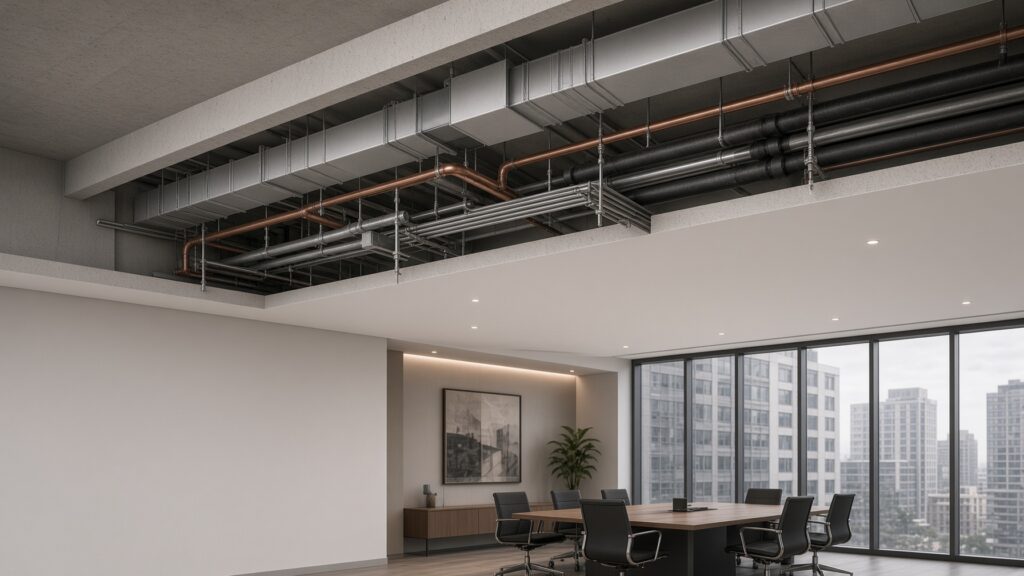
WELL certification is usually worth it for a South Florida Class A office pursuing corporate and institutional tenants. Research puts the rent premium for health-certified office space at 4 to 7 percent, against a fit-out premium near 0.5 percent. It is a leasing decision before an engineering one, and most of the cost sits in the MEP systems.
How much does WELL certification add to office rent, and why?
While WELL certification is usually worth the effort for Class A office spaces in South Florida pursuing corporate and institutional tenants, research suggests a premium for a health-certified office space of 4–7% compared to the fit-out premium.
Nevertheless, it is a leasing decision prior to an engineering one, it is not the only possible certification, and it depends on the submarket in question. All in all, the costs involved concern mechanical, electrical, and plumbing (MEP) systems predominantly.
The most reliable figures come from a 2020 MIT Real Estate Innovation Lab study involving ten U.S. cities and comparing WELL- and Fitwel-certified offices to nearby uncertified offices, having controlled for LEED certification, building age, renovations, lease term, and submarket. As a result, the former were shown to rent 4.4–7.7% more per square foot.
Given that the control group included all the factors listed above, this figure could be considered a reliable result rather than a marketing trick. Apply it to South Florida, which is a market in itself. The question is why the premium arises, as this is what will determine whether your specific property will benefit from it.
There are three drivers of the premium: a post-pandemic flight to quality, meaning that tenants consolidate in the best and thus the healthiest spaces; non-negotiable ESG requirements for large companies, which won’t tour offices unable to meet their reporting needs; and the retention of employees, as healthier space helps to do so at renewal time.
The last driver comes with the leasing velocity effect: the certified spaces tend to lease faster and stay more occupied, and CBRE sees a rent premium for the certified offices as an enduring pattern through economic cycles. Naturally, the premium is tenant-driven, as the case is particularly strong for corporate and institutional tenants.
WELL, Fitwel, or LEED, which certification actually fits?
Owners tend to confuse these certifications, but they are not exchangeable. LEED covers the environmental performance of buildings including energy, water, materials with some health elements, and this drives the sustainability narrative.
WELL and Fitwel cover human health with the concepts of air, water, light, thermal comfort, movement, and mind, however, at significantly different price points.
While WELL v2 is the ultimate certification covering ten concepts and awarding Bronze to Platinum levels with the mandatory third-party testing of air and water, Fitwel certification is designed to be lightweight: there are no prerequisites, the certification is self-documented, and is significantly cheaper.
The difference between the costs is well-known: according to industry estimates, Fitwel registration should cost around $500, while WELL certification is estimated to cost around $2,500.
Moreover, the difference may reach an order of magnitude for the certification of a large office space: for instance, in one comparison, it was estimated as $9,500 for Fitwel versus around $98,000 for WELL Core certification of a million square feet.
For the developer, the WELL certification carries more weight with the institutional tenants and is the stronger leasing signal for a trophy Class A asset, but Fitwel is still a legitimate option in case the tenant base of your building won’t bear the cost of WELL.
Moreover, many owners choose to combine LEED with health certification in order to preserve the ESG and energy narrative.
How much does WELL certification cost?
Significantly less than many owners think relative to the resulting premium, but public information is outdated.
Early estimates of the additional fit-out cost, mostly based on WELL’s first projects, vary between $1 and $4 per square foot. Another estimate suggests adding 0.5% to the office fit-out with the WELL certification, but take it as a reference point only. Additional costs include IWBI enrollment and per-square-feet program fees, as well as mandatory performance testing.
Recurring costs involve the three-year WELL v2 certification cycle and the need for more energy-intensive ventilation and filtration, meaning more expenses on operations. If the scope exceeds the rent you could get in your submarket, Fitwel certification or combining LEED with Fitwel is the cost-effective alternative.
What does WELL require from a building’s MEP systems?
In addition to air and water, although they are dominant, WELL’s Air concept requires ventilation and outdoor air delivery following ASHRAE 62.1 or an equivalent standard, enhanced filtration, monitoring, and source control. Water-related concerns include NSF 61/372-compliant components and attention to standing water in the dead legs of the domestic loop.
There are two concepts directly affecting the work of the MEP engineer: the definition of the acceptable temperature and humidity range with the requirement of dehumidification in this climate in the Thermal Comfort concept and the limit of the background noise in the Sound concept, which means careful selection and positioning of the HVAC equipment.
It is necessary to find a balance here: increased ventilation and filtration mean increased energy consumption, which contradicts the energy code and the owner’s budget for operating the building.
The solution is energy recovery in the form of an outdoor air (DOAS) system with an energy-recovery wheel: the pre-conditioning of the incoming air with the exhaust allows for achieving WELL ventilation requirements without full energy penalty. Little of this could be done at low costs after designing the air-handling system.
Why does more fresh air cost more here?
Because in Zone 1A every cubic foot of the additional outdoor air means the additional latent load of the humid air needing dehumidification before delivering it into the occupied space. Increased ventilation without humidity control may cause exactly the mold problem that WELL certification seeks to solve.
Thus, a WELL air strategy in a hot-humid market is always coupled with the dehumidification strategy, which is why DOAS system with the energy recovery wheel is crucial for the design.
WELL certification is a leasing decision disguised as an engineering one.
The scope is significant, but the case is driven by the rent rather than by the virtuousness.
Does WELL pay off for the owner or just the tenant?
Both, but through different channels and in the proper submarket.
Tenants enjoy productivity and retention, while owners benefit from the rent premium and the faster lease-up, and increasingly from the asset value and exit premium, as the recurring premium increases the NOI and thus capitalizes to the value of the building, and the certified, ESG-reportable building is among the properties screened by the institutional buyers and lenders.
That’s why the decision involves both the developer and the capital partner, not only the design team. The catchphrase remains: make sure your submarket tenants and future buyers would pay for it, as in a market where this doesn’t happen, the premium may not occur.
The recommendation. Make the decision regarding the certification path: WELL, Fitwel, LEED, or their combinations, prior to completing schematic design, as the ventilation, filtration, thermal comfort, and dehumidification sizing depend on it, and switching in the middle of the design process would mean re-sizing of the air handling and re-thinking of the electrical service.
Perform the leasing and engineering analysis in parallel: make sure your submarket tenants and buyers pay the premium, choose the certification that costs appropriate to the premium, and make your engineer price the air-and-water scope with the energy-recovery humidity strategy included.
Our Indoor Environment & Wellness service covers the air, thermal, and water side of a WELL or Fitwel decision, which is where most of the certification cost sits. If you are choosing a certification path for an office, reach out to us before schematic design closes.
Sources: MIT Real Estate Innovation Lab (2020) — health-certified rent premium, ten U.S. cities · GRESB — WELL vs. Fitwel comparison & cost · CBRE — endurance of the certified-office rent premium · ULI — WELL cost per square foot & business case · ASHRAE 62.1 — ventilation