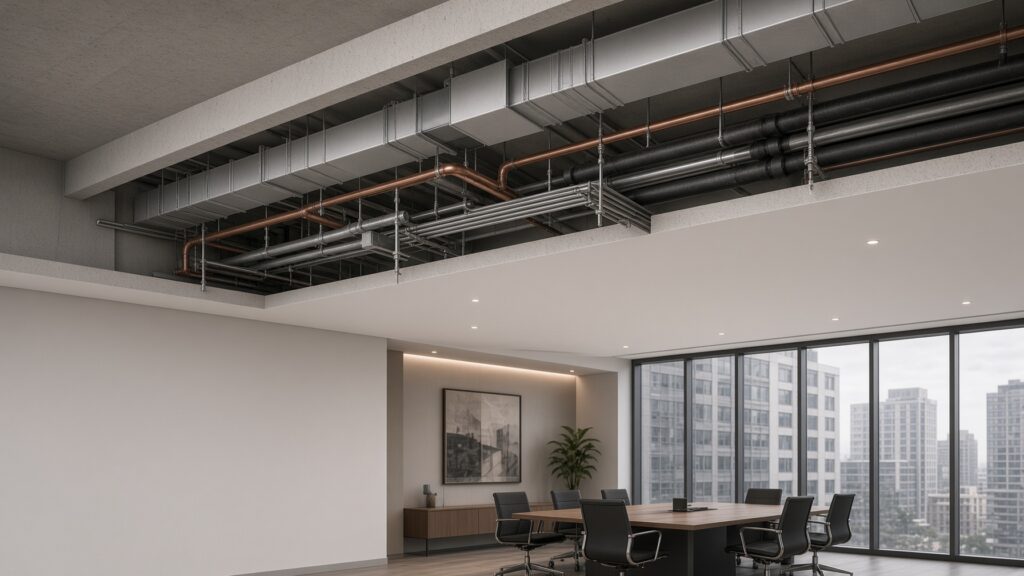
Over ten years, VRF can cost less to own than a central chiller plant in many South Florida buildings. In a large Miami high-rise the central plant usually wins, because part-load efficiency and a smaller footprint outweigh its higher installation cost. Installation is one line on the bid; ownership is ten years of energy, maintenance, and humidity risk.
Is VRF cheaper than a central chiller system?
In a ten-year time span, the VRF may have lower ownership cost than the central chiller plant in many South Florida buildings.
Nevertheless, in a big Miami skyscraper, the central chiller plant always turns out to be more cost-effective in terms of cost of ownership due to its better part load efficiency and smaller footprint despite having a higher initial installation cost. The initial installation cost is just one line item in the bid sheet.
On the other hand, the cost of ownership involves ten years of energy use, maintenance cost, humidity risks, electricity, and the monetary value of roof that the building could have made off. The system that is less expensive in terms of installation does not remain less expensive in terms of cost of ownership.
Cheaper to install, not necessarily cheaper to own. The variable refrigerant flow (VRF) approach usually involves lower upfront cost, because there is no central chiller, no cooling tower, and no chilled water distribution. That is why the VRF system is usually chosen in the end of schematic design.
But the upfront cost is just one factor among the ten-year lifecycle cost curve. The load of the design system occurs just for a limited time per year; for most of the time the building works at much smaller load. South Florida belongs to ASHRAE Climate Zone 1A, where there are more than 9,000 cooling degree days (base 50°F).
Thus, part load condition is significant and not marginal, rather it covers the whole year. Ownership includes costs that usually are not included in the bid, the energy use over the whole cooling season, the maintenance that will be needed over many individual units rather than several central units, and shorter life of the equipment.
The average lifetime of VRF condensing units is 15-20 years, while the well-maintained chiller has 23-25 years of its lifetime. The key point in determining the cost of ownership is the part load efficiency of the equipment during its lifetime.
Which is more efficient, VRF or a chiller, and when does the chiller win?
For maximum capacity conditions, a central chiller would be more efficient (COP of around 5-7 compared with 3-5 of VRF), but for part-load operation, where VRF’s modulation and real zoning will be able to condition only used spaces, there is an edge for VRF.
Consequently, VRF will prevail when considering midsize, well zoned buildings with diverse and varying loads. The advantage becomes less significant as the size gets bigger. For instance, a big tower using water-cooled chiller plant could get down to 0.5-0.6 kW/ton, which would make it competitive, if not more efficient, at load above several hundred tons or about 1,000 tons.
Here, too, VRF faces physical restrictions because of the nature of the system itself.
For example, ASHRAE 15 Standard limits the amount of refrigerant in the occupied space, while manufacturers have restrictions regarding the vertical distance of piping of up to 150 feet (up to 15 floors) and horizontal run of up to 500 feet from condensing unit to the farthest one.
One VRF rooftop bank couldn’t get to the bottom floor of a tall building. The choice is basically mathematical.
How does VRF vs. a central plant change electrical service, roof space, and drainage?
Take a 400-unit multifamily project with hundreds of cooling tons.
The selection impacts four areas in ways not even hinted at in the bid sheet:
- With distributed VRF, there could be hundreds of fan coil units indoors with their drains and condensate pumps, hundreds of leak points in a climate that produces condensate every single day.Every condensate pump is a motor that can break down, and every drain pan has a risk of mold formation.
In a central air conditioning system, all of these items are condensed into just a few big drains that an operator can observe.
- In a VRF system, refrigerant is transported through occupied spaces, so each zone’s refrigerant charge must be measured against ASHRAE 15 concentration restrictions and modern A2L refrigerants used in the system are mildly flammable, which implies additional measures to detect and address leaks when certain concentration is exceeded.Also, a large VRF system will store a considerable quantity of refrigerant spread out over the whole building.
A central plant system will keep its refrigerant charge contained in the machine room and use water transport only in occupied spaces.
- VRF will place many small inverter-driven loads through the building, allowing for softer startups and diversified peak, but feeder and panel distribution will take place to dozens of outside units on every level served.Central plant places a few big motor loads behind one feeder and panel setup. Two solutions lead to quite distinct service, riser and panel configurations.
- This is where the tower differs from the mid-rise. Hundreds of tons of heat rejection capacity have to be accommodated somehow.Central plant will concentrate it, with chillers in the plant room and cooling towers in one screened roof area or mechanical floor with a clear footprint.
With VRF, there will be dozens of condensing units scattered on the roof and façade, each needing clear air intake in order to avoid recirculating its heat back and servicing, supporting structure, hurricane anchoring and corrosion protection in case of salt air.
They occupy exactly the rooftop space that a developer was planning for a pool, a penthouse or a rentable amenity. Given the pipework considerations outlined above, a tall building cannot fit all units on the roof; some have to go to intermediate mechanical floors, shrinking rentable space.
Vertical distance of roughly 150 feet (or about 15 floors) has a significant impact on the decision for a tall building: a central plant rejections all heat in one roof area or mechanical floor regardless of the building height, while VRF cannot do it. The higher the building, the better the footprint of the central plant solution is.
The hidden benefit of the central plant solution in the biggest one.
A system selected at schematic design stage determines the costs, humidity risk, electrical service and roof plan for a decade. It is the costliest line item with no possibility of negotiating.
Does VRF dehumidify well in a hot, humid climate?
Absolutely not.
Such climate is a very important issue to note. A coil can remove moisture only if it is cold enough to condense water.
While the VRF coil is modulating down under partial loads, the coil operates hotter, the sensible heat ratio goes up, and the latent (moisture removal) capacity goes down towards zero, right during the mild and humid hours that prevail in South Florida. The fan coils of VRF systems are poor dehumidifiers even in theory.
Operating such system at a constant temperature with relative humidity above 60% means trouble with mold complaints and all the responsibilities it entails. It is not about saying that the VRF system does not dehumidify. It is about combining it with a separate dehumidification (DOAS, a Dedicated Outdoor Air System) properly sized and budgeted for in the overall comparison.
Exclusion of this point will make VRF system look more advantageous and underestimate the project’s size.
How does the R-410A-to-A2L refrigerant change affect the decision?
There is a change in the makeup of the equipment that is being purchased, having a greater effect on VRF equipment than on central equipment.
R-410A VRF equipment stopped being produced on January 1, 2026; modern-day VRF systems use A2L refrigerants, like R-32 and R-454B.
A2L refrigerants are slightly flammable, and their use within an occupied area requires following leak detection, alarm, and mitigation measures as explained above, which is an important cost implication for the fact that the refrigerant must go to each individual zone.
(According to the EPA 2026 relief program, existing R-410A can still be installed until January 1, 2027, and through 2028 if the project was permitted before October 2023; but it is simply the reduction of old stock, and not an implication of modern design.) Central chilled-water plant will keep the refrigerant charge inside the machinery room, circulating only water in the building, and therefore is shielded from the transition; but choosing VRF equipment includes the entire occupied space.
The recommendation. Consider HVAC as an obligation to own for ten to fifteen years, not as a line-item expense on the bid day, and make decisions while working on the schematics.
Ask your engineer for a comparison which the bid hides – issues such as part load energy efficiency and peak demand impact, maintenance and life expectancy of equipment, condensate safety, refrigerant safety, roof and electrical service space requirements, A2L refrigerant transition, and if the design includes coupling the system with the dehumidification necessary for a humid environment.
In a 400 unit building, the right decision would be the one that results in good results in all of these aspects, not just the cheaper installation.
We prepare this comparison at schematic design, it is core work under our Integrated MEP Design service, and it is where the ten-year cost gets decided. If you have a tower in early design, reach out to us and we will talk it through.
Sources: ASHRAE 169 — climate zone 1A · VRF vs. chiller efficiency and lifecycle · VRF piping length & elevation limits · ASHRAE 15 / A2L leak detection · VRF part-load dehumidification · EPA VRF final rule / A2L transition · NAHB — EPA R-410A install relief (May 2026)